Access Isn’t Adoption: Why AI Investments Fail Without Workforce Development
Access Is Growing, but Results Aren’t
Your AI investment may be failing because your workforce was never taught how to use it.
Many organizations think they’ve solved AI adoption because they purchased enterprise licenses. In reality, they’ve only solved access. The bigger challenge is helping employees produce work that is accurate, compliant, on brand, and genuinely useful.
Buying enterprise AI licenses is easy. Building an AI-capable workforce is the hard part.
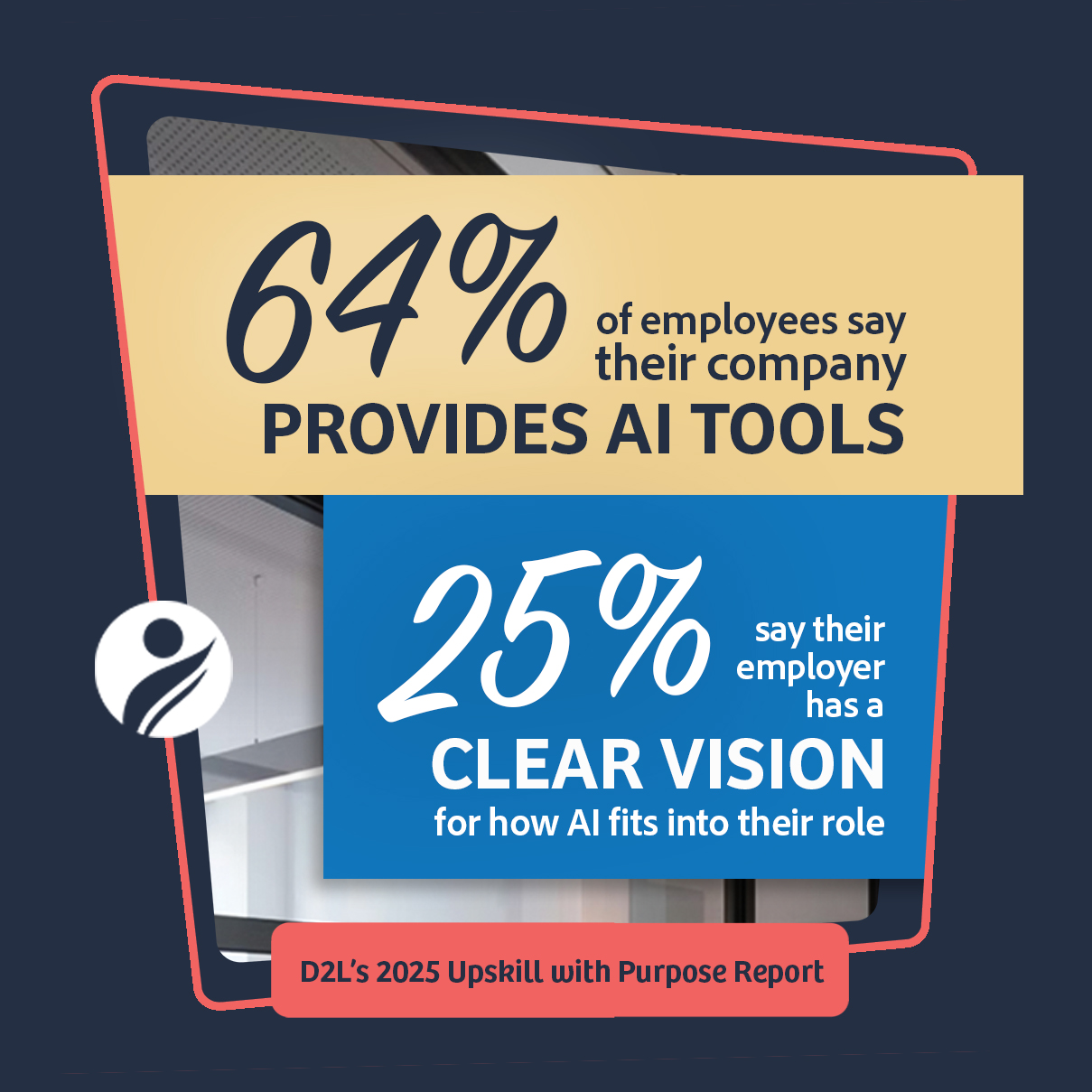
The research reinforces this point. According to D2L’s 2025 Upskill with Purpose report, 64% of employees say their company provides AI tools. Yet only 25% strongly agree that their employer has a clear vision for how AI fits into their role. That disconnect helps explain why organizations are seeing inconsistent results. Employees are optimistic, with 69% believing AI will help them do their jobs better, but too many are still learning through experimentation instead of intentional training.
Without clear expectations, governance, and practical instruction, employees often default to generic AI-generated content. That can lead to inconsistent messaging, unnecessary compliance risks, and missed opportunities to create work that reflects the organization’s expertise and brand (Karnis, 2025).
Managers Need More Than Training Catalogs
The challenge extends beyond employees. Managers are increasingly expected to coach teams on effective AI use, but many have not been equipped to do so.
LinkedIn’s 2025 Workplace Learning Report found that 50% of organizations say managers lack the support they need to coach employees in learning and development. Training libraries and online courses certainly have value, but resources alone rarely change workplace behavior. Employees need clear use cases, opportunities to practice, feedback from their managers, and an understanding of when AI should and should not be used (2025 Workplace Learning Report).
AI Adoption Is Really a Workforce Development Strategy
The organizations making the greatest progress recognize that AI adoption is not primarily a technology initiative. It is a workforce development initiative.
Rather than expecting employees to figure things out on their own, they establish structured learning pathways, identify role-specific use cases, provide governance around responsible AI use, and equip managers to reinforce new skills. As a result, AI becomes part of everyday work instead of another application employees are expected to navigate independently.
This approach is echoed by IBM, which emphasizes that organizations adopting AI successfully invest in employee training and establish responsible AI governance to improve trust and reduce implementation risks. AI adoption succeeds when organizations create an environment where employees understand not only how to use AI, but also when to use it, how to validate its outputs, and how to apply it responsibly.
That approach pays dividends. D2L reports that organizations with strong career development champions are 42% more likely to lead in generative AI adoption. Strong learning cultures are also better positioned to adapt as AI capabilities continue to evolve (Stryker, 2025).
Turning AI Investments into Business Value
For employers, the takeaway is straightforward. Purchasing AI technology is an investment. Realizing its value requires an equal investment in people.
When employees understand how AI supports their work, know how to apply it responsibly, and have managers who can reinforce those skills, organizations see better outcomes. The goal is not simply to use AI more often. It is to use AI more effectively, producing work that is higher quality, more consistent, and aligned with organizational goals.
The Conversation We Need to Have
At the Center for Professional Development, this is exactly the conversation we want to have with employers and organizations throughout our region. As organizations move beyond AI experimentation, the need for practical workforce development has never been greater. Our AI training programs are designed to help employees build the skills, confidence, and judgment to use AI effectively in their day-to-day work, while helping organizations maximize the return on their technology investments.
If your organization is thinking about AI upskilling or developing a broader workforce training strategy, I would welcome the opportunity to continue the conversation.
Written by: Lois McWhorter, PhD | July 20, 2026
Sources: .
2025 Workplace Learning Report | LinkedIn Learning. (2025). In Linkedin.com. https://business.linkedin.com/learn/resources/workplace-learning-report
Karnis, K. (2025). Employee training statistics and trends to know in 2026. In D2L. https://www.d2l.com/blog/employee-training-statistics/
Stryker, C., & Kavlakoglu, E. (2024). What is artificial intelligence (ai)? In IBM. https://www.ibm.com/think/topics/artificial-intelligence